Delivery Protocol Explainer
A practical reference for understanding how television-grade programming is routed differently than open-internet video, and why those routing choices materially shape the viewer experience.
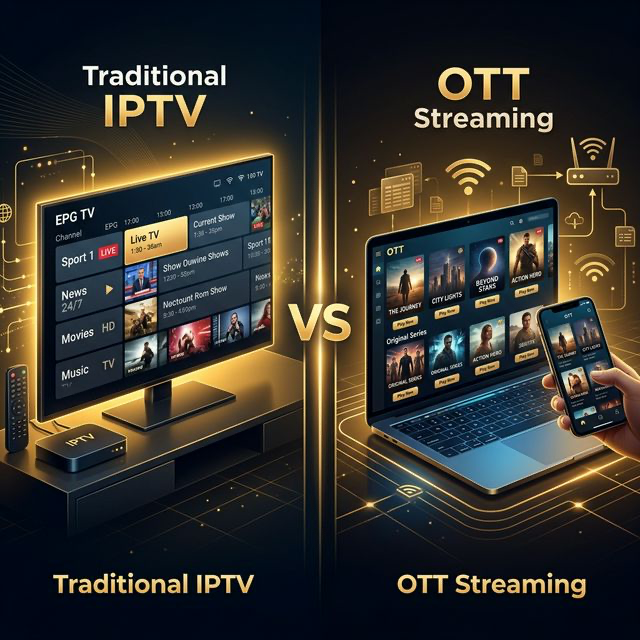
Managed-network model
Programming flows through dedicated infrastructure with deterministic routing. The operator owns the path from origin server to viewer edge, applying load-balancing logic and per-stream user caps. Because traffic does not contend with general internet traffic, latency stays low and quality stays consistent under load.
Open-internet model
Video packets share the same public links as web browsing, gaming, and email. Standard CDN nodes serve general-purpose content; quality is governed by adaptive bitrate logic, which degrades resolution rather than dropping the stream when the network gets busy.
Side-by-side routing characteristics
| Characteristic | Managed network | Open internet |
|---|---|---|
| Path ownership | Single operator, end-to-end | Shared with public traffic |
| Latency profile | Low & predictable | Variable, spikes during peaks |
| Live event behaviour | Holds 4K under load | Drops to lower bitrates |
| Channel switching | Sub-second | Multi-second buffer |
| Catalog scope | 29,500+ feeds & 200,400+ titles | Per-platform fragmented |
| Sports rights | Multi-region coverage | Splintered across apps |
| Monthly outlay | Single subscription | Stacked subscriptions |
| Program guide | Interactive EPG | Browse-based shelves |
| Buffering risk | Mitigated by dedicated routes | Higher during peak hours |
| Hardware support | Universal player ecosystem | App-specific dependencies |
Routing topology in practice
Open-internet streaming relies on best-effort packet delivery. When evening congestion peaks, your video competes with every other byte traversing the same backbone. Adaptive bitrate logic compensates by reducing quality, which is why a perfect 4K stream can quietly slip to a soft 720p.
Managed-network platforms sidestep that contention by routing through dedicated origin and edge nodes. The result is predictable bandwidth, sub-second tune-in, and stable resolution throughout the broadcast.
Catalog architecture and discovery
Open-internet platforms each host a distinct content slice behind their own paywall. The viewer therefore juggles multiple apps, login sessions, and remote contexts. Discovery is fractured; search results never span the entire universe of available programming.
Managed-network platforms unify discovery into a single channel grid and VOD shelf. A single search query returns matches across all available regions, languages, and genres — reducing friction at the moment of intent.
Live sports latency
Latency is the most visible quality differentiator during live sport. Open-internet streams typically run 30 to 60 seconds behind the broadcast feed because of segment-based delivery (HLS/DASH chunks). Managed-network paths stream continuously and can hit near-broadcast latency.
For viewers who track scores on social media or who watch alongside others elsewhere, the latency gap is the difference between celebrating a goal in real time and receiving a spoiler in their notifications.
Hardware and player flexibility
Open-internet platforms ship proprietary apps. Device support is dictated by commercial agreements; rollout to new hardware is often delayed. Viewers with eclectic device mixes face fragmented experiences.
Managed-network programming is consumed through any player that speaks the standard Xtream Codes API or M3U manifest format. That means Firestick, Android TV, Apple TV, Samsung Tizen, LG webOS, MAG hardware, desktop, and mobile all behave the same. Check our supported devices reference for the full compatibility list.
Bandwidth efficiency and codecs
Both delivery models support modern codecs (H.265/HEVC and increasingly AV1). The practical difference is how the codec is applied. Open-internet platforms favour conservative bitrates so many concurrent viewers can be served from shared CDN nodes.
Managed-network platforms allocate generous bitrates per stream because route capacity is reserved. A typical home connection of 25 to 40 Mbps sustains flawless 4K throughout primetime, with standard HD running comfortably on 10 Mbps.
When each model fits
Open-internet streaming remains a sound choice if your household watches predominantly on-demand catalogs from a single provider and rarely tunes into live broadcasts.
Managed-network platforms become the better option for viewers who follow live sports across multiple leagues, who want a single comprehensive program guide, and who value low-latency delivery during marquee events.
Golden IPTV Pro brings the managed-network model to households at a price point that undercuts stacked open-internet subscriptions while delivering measurably better quality during live programming.
See managed-network delivery in action
Pick a subscription tier and start streaming on any compatible device within minutes.